1) The Ruy Lopez
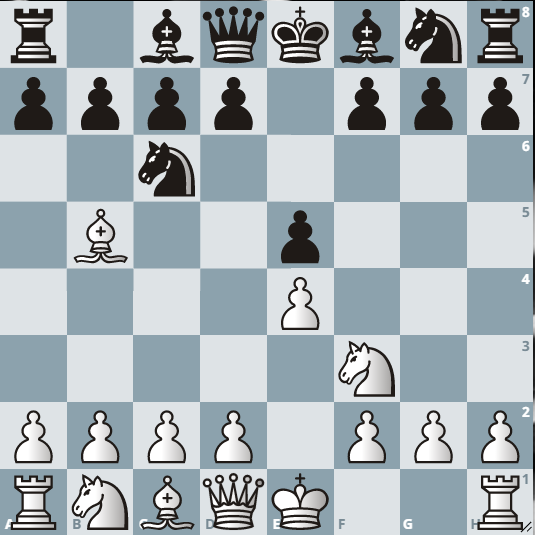
The Ruy Lopez, also known as the Spanish opening is probably one of the most common, if not the most common opening that beginners play without even realizing it. It is one of the best openings to learn as a beginner as it is very basic and leaves open a lot of room for the basic development of pieces, as well as preventing your opening from developing some of his pieces.
This opening is one of the oldest openings in the history books and as already said, one of the most popular ones. The opening was named after a Spanish priest, Ruy López de Segura, who lived during the 16th century
This opening is popular at all levels of chess. Even high elo players like Caruana, Carlsen, and Anand enjoy to play this opening and pull it out quite frequently as it is quite versatile, hence also being very popular among beginner players. It goes even as far as being considered to be the essential opening for the development of any promising player. At the very beginning, the opening is quite fast, however towards the middle game, the entire game turns into positional gameplay.
The opening begins in the following way: 1.e4 e5 2.Nf3 Nc6 3.Bb5 (Look at the example above).
White has a few things it wants to achieve with these moves. First, he would like to take control of the center with the very first move, e4. This also opens up the window of development for the white square bishop and the queen. With the second move Nf3, white is immediately trying to put more pressure on the center of the board and is looking to attack blacks e5 pawn right away, forcing black to defend the pawn. Black obviously has to not fall behind in development and defend the pawn at the same time, so he plays the move Nc6.
After black develops his knight to c6, white immediately plays Bb5 putting more pressure on blacks pieces, this time threatening to take the knight on c6 which would result black in getting double pawns (something that you should always try to avoid getting), as well as winning himself a free pawn on e5 as when BxNcg6, black obviously has to take back with one of his pawns, which will then open up a window of opportunity for white to take the pawn on e5 since it will no longer be defended by the knight.
2)The Sicilian Defense
Dragon Variation

Like The Ruy Lopez, The Sicilian Defense is one of the most played openings by players of all level, as it can variate into multiple different scenarios. One of those scenarios is the Dragon Variation. As a Dragon player myself, I will show you how you can achieve the opening and what your main goals and objectives with this opening are.
This opening is known and feared by any 1. e4 player as it is one of the most feared counterattacking options that black has against the move e4. However, the opening at times can be very unpredictable and more often than not the positions that will occur out of it will be a double-edged sword. Therefore it is highly important to pay precise attention when playing this opening. As J.R.R. Tolkien once said, “It simply isn’t an adventure worth telling if there aren’t any dragons.” (www.ichess.net)
Let’s get started. As already said, this opening is a variation of The Sicilian Defense. In the example above, you can see the Dragon Variation set and finished. In order to achieve that position, the moves must be the following: 1.e4 c5 2 Nf3 d6 3 d4 cxd4 4 Nxd4 Nf6 5 Nc3 g6. This then more often than not gets followed up by black fianchettoing his dark-squared bishop on f8, by playing Bg7.
The main idea behind this opening is for black to utilize his black squared bishop as much as possible and put him on that strong diagonal on g7. The dark squared bishop for black will be his main weapon in this opening, used both for attacking white’s center and queenside, as well as defending black’s kingside when necessary.
So, what are the advantages of playing the Dragon Variation and why is it such a feared weapon of black? The answer to that is simple, flexibility and coordination. The Dragon Variation is very flexible and can even variate into the Accelerated Dragon or the Hyper-Accelerated Dragon. For a beginner player, I would not recommend going into playing the Accelerated Dragon or the Hyper-Accelerated Dragon and try to just stick to the normal Dragon Variation, as those can be more confusing and extensive for beginners. In terms of coordination, all of blacks pieces are positioned in such a way, where they benefit each other and are in a way achieving harmony between each other. Black’s bishop is ready to attack at any time, he has a solid pawn structure, and he has a lot of play capability heading into the middle and end game. The only thing you should be worried about as black is the d5 square, as white is preventing you to gain control of that square with his pawn on e4. White’s future plan might be to gain control of that square and utilize that weakness against you, so always watch out and keep track of how white is positioning his pieces.